
Why SaaS Companies Are Hiring Fractional Designers Instead of Full-Time
You have a product that works. Users are coming in. But the interface is held together with duct tape, the marketing site hasn't been touched in a year, and every new feature ships looking slightly different from the last one. You know you need serious design help.
So you start hiring. And that's where things get complicated. A senior product designer in the US or Western Europe costs $120K-$180K fully loaded. The hiring process takes months. Onboarding takes more months. And if it doesn't work out, you're back to zero with less runway.
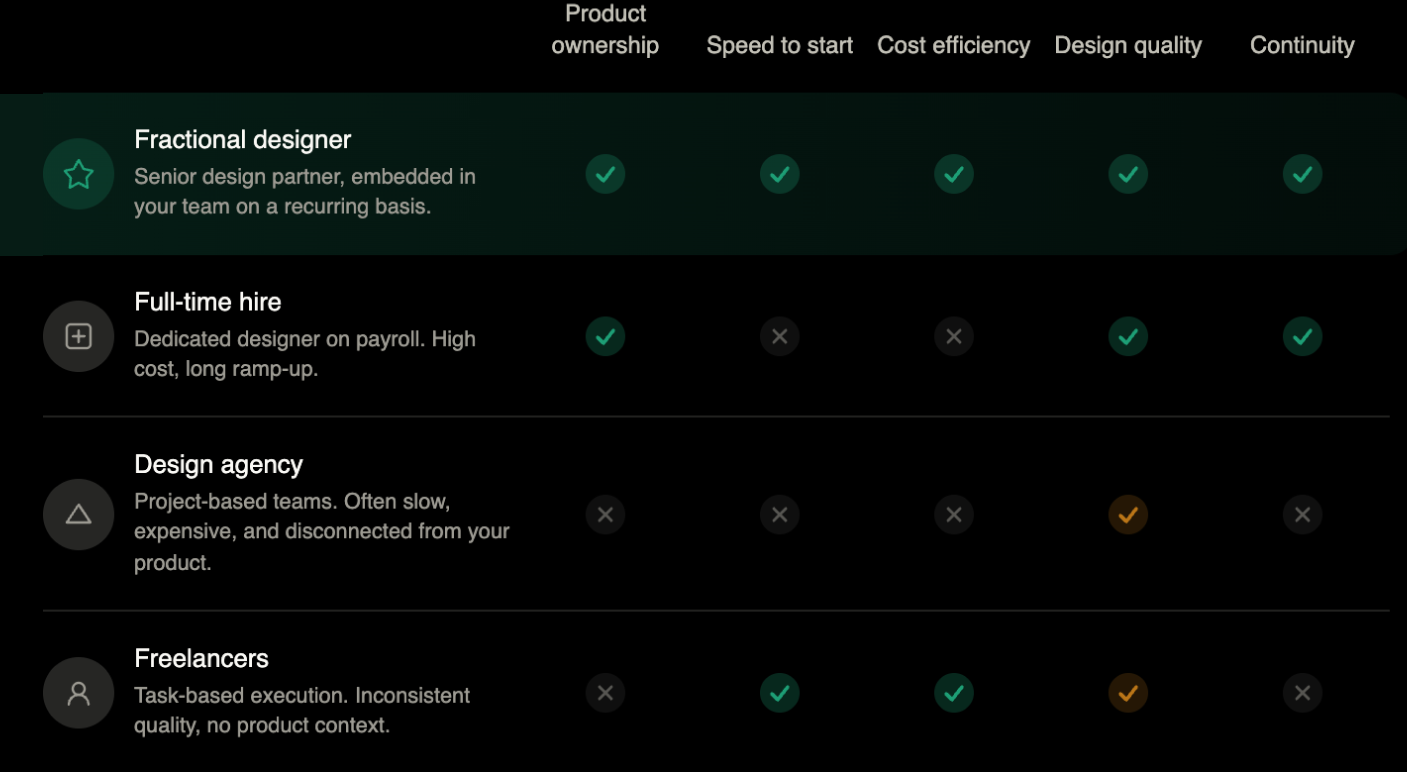
There's another option that more SaaS companies are choosing: hiring a fractional designer. Not a cheap freelancer for one-off tasks. A senior design partner who works with you continuously, owns the design layer of your product, and operates like a team member, without the full-time commitment.
The Hiring Problem Nobody Talks About
Most SaaS companies between 10 and 50 people don't actually have enough design work to justify a full-time senior hire. They have bursts. A new feature needs UX thinking. The website needs a conversion overhaul. A pitch deck needs to look credible. Onboarding screens need a rethink.
These are all real, important problems. But they don't add up to 40 hours of senior design work every single week, 52 weeks a year.
What happens instead: you hire full-time, the designer is busy for two months, then spends the next two months doing low-impact polish work because there's nothing strategic on the board. Or worse, you don't hire at all, and your product accumulates design debt until it becomes a real problem for retention and conversion.
A fractional product designer fills this gap. You get 20, 40, or 60 hours a month of focused senior work. When there's a big push, capacity is there. When things are quieter, you're not paying for idle time.

Fractional Doesn't Mean Part-Time Thinking
The biggest misconception about fractional design is that it's somehow less committed than full-time. That you're getting someone who's half-paying attention, juggling ten clients, treating your product like a side project.
That's the freelancer-for-hire model. Fractional is different.
A good fractional designer for SaaS companies works as an embedded partner. They learn your product deeply. They understand your users, your business model, your technical constraints. They're in your Slack, your Figma, your sprint planning. The difference is structural, not attitudinal: they provide senior design ownership on a recurring basis, scoped to what your company actually needs.
For most growing SaaS teams, this is a better fit than full-time. You get depth and continuity without the overhead.
What a Fractional Design Partner Actually Does
This varies, but for a typical SaaS or software company, a fractional designer covers:
Product UX and Interface Design
User flows, feature design, dashboard layouts, complex form experiences, onboarding, settings, admin tools. The core product work that directly affects how users experience your software.
Website and Conversion
Your marketing site is a product too. A fractional partner can own the structure, messaging hierarchy, and conversion logic of your site, not just make it look nice but make it actually perform.
Design Systems and Consistency
Components, tokens, spacing logic, typography rules. The kind of foundational work that prevents every new screen from looking like it was designed by a different person. Most startups skip this until it becomes painful. A fractional designer builds it incrementally.
Strategic Design Input
Sitting in on product discussions. Asking the right questions about user needs before jumping into pixels. Pushing back when a feature request doesn't make UX sense. This is the part that's hardest to get from project-based freelancers, because it requires context that only builds over time.
When Fractional Design Makes the Most Sense
This model works best for companies in a specific stage. You've found product-market fit (or you're close). You have real users. Revenue is growing. But you're not at the point where building a full internal design team makes sense.
Typical signals that fractional is the right move:
- Your product is shipping, but design quality is inconsistent.
- You've been using a mix of freelancers and the results feel disconnected.
- Your founding team handles design decisions, but nobody has real design expertise.
- You need someone senior enough to make design decisions independently, not just execute tickets.
- You want design continuity across product and website, not siloed project work.
If three or more of these sound familiar, you probably don't need to hire full-time. You need a fractional design partner who can own the full picture.
The Cost Comparison That Matters
Let's be direct about numbers. A senior product designer in most major markets costs $120K-$180K per year in salary alone. Add benefits, equipment, management overhead, and the cost of a bad hire, and you're looking at $150K-$220K in real spend.
A fractional design partner typically runs $3K-$8K per month depending on scope and seniority. That's $36K-$96K per year for ongoing senior design work, with the flexibility to scale up or down as your needs change.
But the real savings aren't just in the dollar amount. It's the speed. No three-month hiring process. No onboarding ramp where someone is learning your codebase and product for weeks before becoming productive. A good fractional designer gets productive fast because they're used to embedding quickly in new environments. That's the skill.
How to Make Fractional Design Work
The model only works if both sides treat it seriously. A few things that matter:
Give real access. Slack, Figma, product repos, analytics. A fractional partner can't make good decisions in an information vacuum. Treat them like a team member, not a vendor.
Define scope, not tasks. Instead of handing over a Jira ticket queue, align on outcomes. "We need the onboarding experience redesigned this month" is better than "make these 14 screens." Senior designers do their best work when they have ownership over the problem, not just the pixels.
Commit to continuity. The value of fractional compounds over time. The first month is good. By month three, the designer knows your product well enough to challenge assumptions and catch problems early. By month six, they're operating like an internal team lead. Short engagements miss this entirely.
The Shift Is Already Happening
The fractional model isn't new in finance, marketing, or engineering. It's just catching up in design. And it's catching up fast, because the economics and the talent dynamics make sense for the exact companies that need design the most: growing software businesses that care about quality but can't justify the full-time overhead yet.
If your SaaS product is at the stage where design decisions directly affect growth, retention, and credibility, and you don't have someone senior owning that layer, the question isn't whether to invest in design. It's whether full-time is really the right structure for where you are right now.
For most companies at this stage, it isn't. A fractional design partner gets you senior thinking, real ownership, and the flexibility to grow into a full team when the time is right.
This is exactly how I work with SaaS and software companies at Blending Lab. I embed as a fractional design partner, covering product UX, website, and design systems on a recurring monthly basis. If your team is at the stage where design quality matters but a full-time hire doesn't make sense yet, take a look at how I work and what I offer here.